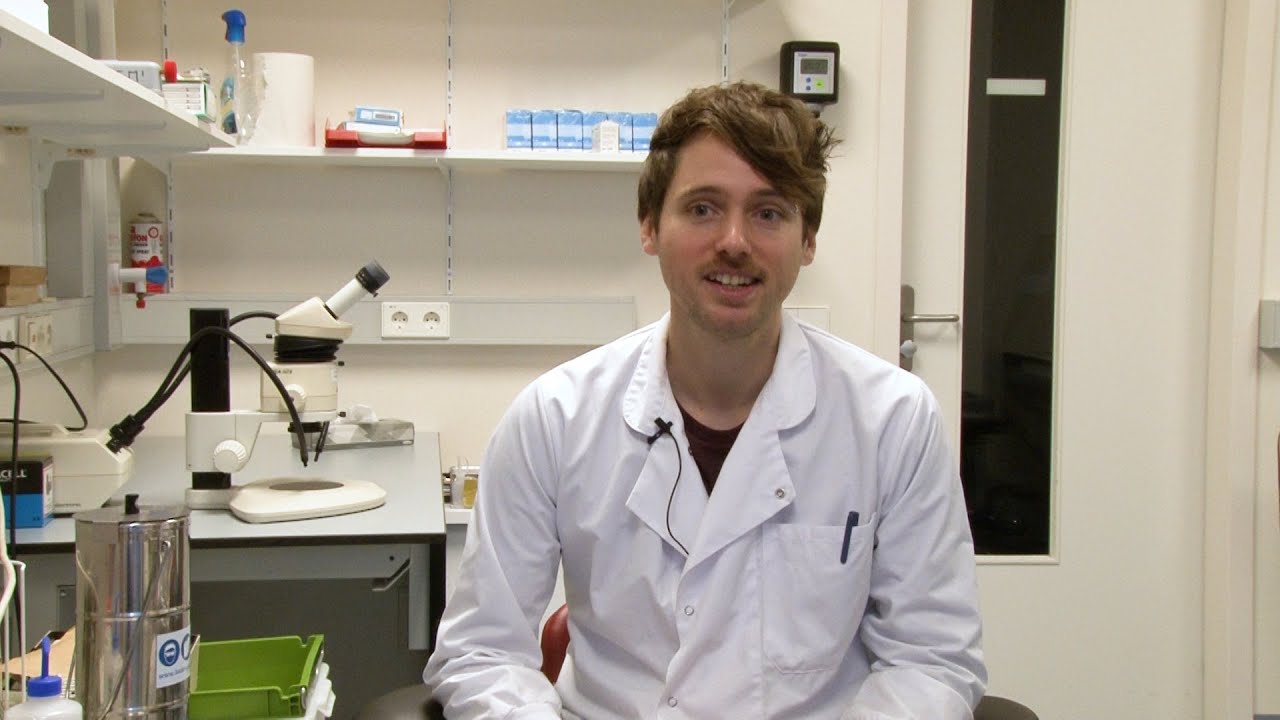
Last year, Gian-Luca McLelland and his colleagues from the Netherlands Cancer Institute discovered that human cells can produce fuel through a different pathway than the one previously known. The fatty molecules they studied are fundamental to human life: most of the energy in our bodies is stored in such triglycerides.
Impressed
Today, McLelland received the Antoni van Leeuwenhoek award 2023 for more than ‘just’ this discovery. Supervisor Thijn Brummelkamp: “I am deeply impressed by Gian-Luca as a scientist, and he is one of the best supervisors of interns that I have met. His accomplishments and passion for science are exceptional.”
Logistical problems
His unexpected finding, published in Nature last year, wasn't quite what Gian-Luca had been looking for in the first place. “I got sidetracked”, he explains. “I wanted to study lipid metabolism. Cells have some logistical problems there: they make lipids in one place, store them in a second and burn them in a third. Some things in the literature didn’t make sense, though.”
He also noticed lipids stored inside droplets in cells that shouldn’t contain them because they lacked the known production route… “That was puzzling,” he says. It would be easy to think: a few droplets, who cares? Well, Gian-Luca did. He cleverly designed a series of experiments in which he selectively switched genes on and off in cells to study the effects. “We discovered that cells have an unknown brake on their triglyceride production. When we removed it, we saw a crazy amount of lipid droplets.”
Massive gaps
“This pair of genetic screens that were designed and carried out by Gian-Luca are among the most elegant and striking genetic experiments that have ever been carried out in my laboratory”, says Thijn Brummelkamp.