(click on the image to enlarge)
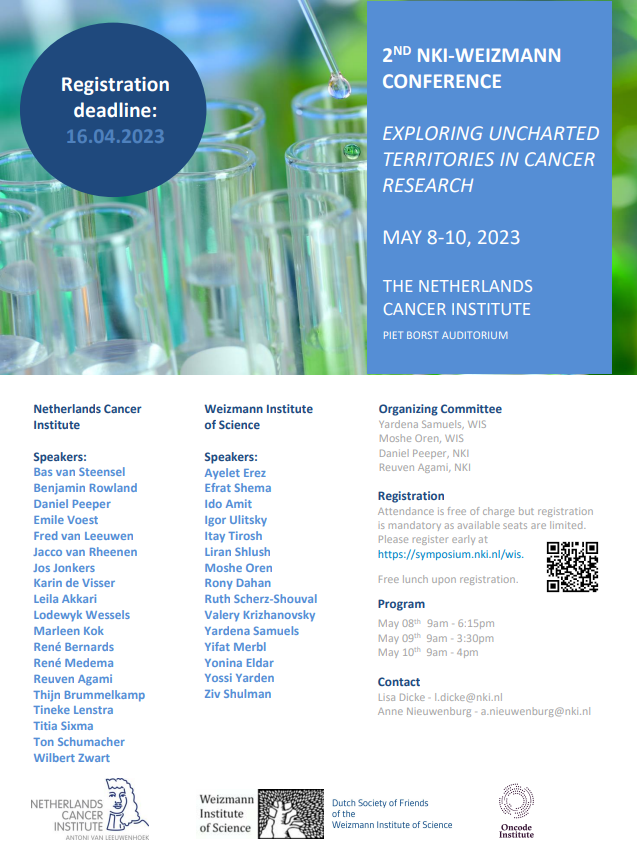
2nd NKI-Weizmann Conference
Exploring uncharted territories in cancer research
Monday 08 May 2023
9am - 6pm
Piet Borst Auditorium
Conference
The second Netherlands Cancer Institute (NKI) - Weizmann Institute of Science (WIS) conference is a sequel to the first successful episode, which was held in Israel in 2016. This conference brings together top scientists from each institute, who will present their latest discoveries. The theme for this year is "Exploring uncharted territories in cancer research". Exciting developments in fundamental, translational and clinical cancer research will be covered. During the conference, there will be sufficient time for discussions and to set up collaborations.
The conference is sponsored by the Friends of the Weizmann Institute, WIS, NKI and Oncode Institute.
The second Netherlands Cancer Institute (NKI) - Weizmann Institute of Science (WIS) conference will be held at the Netherlands Cancer Institute in Amsterdam.
Location
Piet Borst Auditorium
The Netherlands Cancer Institute
Plesmanlaan 121
1066 CX Amsterdam
Organizing Committee
- Yardena Samuels, Weizmann Institute of Science
- Moshe Oren, Weizmann Institute of Science
- Daniel Peeper, The Netherlands Cancer Institute
- Reuven Agami, The Netherlands Cancer Institute
Conference catering
During the conference, complimentary coffee and tea will be provided to all attendees. A complimentary lunch box will be available if registered and indicated on the registration form.
For questions, please contact Lisa Dicke at l.dicke@nki.nl or Anne Nieuwenburg at a.nieuwenburg@nki.nl.
Registration & lunch
Attendance is free of charge but registration is mandatory as available seats are limited. Registration will give you access to a complimentary lunch box.
UPDATE: Registration is closed. It's still possible to visit the lectures, however without registration the lunch box won't be available.
Program
08:30 Coffee/tea/program pickup
09:00 Welcome
SESSION 1
09:05-09:35 Liran Shlush, Weizmann Institute of Science
The aging of the blood system and leukemia evolution
09:35-10:05 Ton Schumacher, Netherlands Cancer Institute
Immune recognition of cancer
10:05-10:35 Efrat Shema, Weizmann Institute of Science
Decoding the epigenome for cancer research and diagnostics
BREAK
11:00-11:30 Jacco van Rheenen, Netherlands Cancer Institute
Intravital microscopy reveals the plastic nature of cancer growth and metastasis
11:30-12:00 Ayelet Erez, Weizmann Institute of Science
Dissecting the host-tumor metabolic crosstalks to improve cancer therapy
12:00-12:30 Fred van Leeuwen, Netherlands Cancer Institute
Deconstructing chromatin by DNA barcoding
12:30-13:00 Yonina Eldar, Weizmann Institute of Science
Model based deep learning for medical diagnosis
13:00-14:00 Lunch
SESSION 2
14:00-14:30 Thijn Brummelkamp, Netherlands Cancer Institute
Deciphering cellular phenotypes using haploid genetics
14:30-15:00 Ruth Scherz-Shouval, Weizmann Institute of Science
From gatekeepers to providers- cancer associated fibroblasts in the tumor microenvironment
15:00-15:30 Karin de Visser, Netherlands Cancer Institute
Elucidating how the genetic makeup of breast cancer shapes the immune landscape
15:30-16:00 Yardena Samuels, Weizmann Institute of Science
Revisiting the neoantigen approach for cancer immunotherapy
BREAK
16:30-17:00 Tineke Lenstra, Netherlands Cancer Institute
Single molecule transcriptomics
17:00-17:30 Yifat Merbl, Weizmann Institute of Science
Proteasome profiling: from global views of degradation to novel mechanisms of anti-tumor immunity
17:30-18:00 Titia Sixma, Netherlands Cancer Institute
DUB gymnastics: allosteric regulation of deubiquitinating enzymes
08:30 Coffee/tea/program pickup
09:00 Start
SESSION 3
09:00-09:30 Igor Ulitsky, Weizmann Institute of Science
A GBA pseudogene is essential for survival of senescent cells
09:30-10:00 Daniel Peeper, Netherlands Cancer Institute
Function-based genomics to combat immunotherapy resistance
10:00-10:30 Yossi Yarden, Weizmann Institute of Science
Mechanisms underlying secondary mutagenesis and resistance of lung cancer to EGFR kinase inhibitors
BREAK
11:00-11:30 Jos Jonkers, Netherlands Cancer Institute
Modeling breast cancer in mice and rats
11:30-12:00 Ziv Shulman, Weizmann Institute of Science
Memories of antibody-mediated immune responses in ovarian cancer patients
12:00-12:30 Reuven Agami, Netherlands Cancer Institute
Amino acid shortages in cancer
12:30-13:30 Lunch
SESSION 4
13:30-14:00 Benjamin Rowland, Netherlands Cancer Institute
Cohesin and chromatin structure
14:00-14:30 Itay Tirosh, Weizmann Institute of Science
Pan-cancer analysis of intra-tumor heterogeneity
14:30-15:00 Bas van Steensel, Netherlands Cancer Institute
Tools to probe genome regulation
15:00-15:30 Ido Amit, Weizmann Institute of Science
The power of ONE: Immunology in the age of spatial and single cell genomics
08:30 Coffee/tea
09:00 Start
SESSION 5
09:00-09:30 Emile Voest, Netherlands Cancer Institute
Challenges and opportunities in implementing genomics-guided medicine
09:30-10:00 Valery Krizhanovsky, Weizmann Institute of Science
Molecular mechanisms of senescence on the crossroads of aging and cancer
10:00-10:30 Lodewyk Wessels, Netherlands Cancer Institute
Detecting and exploiting interaction in cancer
BREAK
11:00-11:30 Leila Akkari, Netherlands Cancer Institute
Harnessing the potential of myeloid cells in brain and liver cancer treatment: a matter of genetics, time and combination.
11:30-12:00 Wilbert Zwart, Netherlands Cancer Institute
Plasticity in Androgen Receptor genomics: probing the epigenome that drives prostate cancer development, progression and metastasis
12:00-12:30 Rony Dahan, Weizmann Institute of Science
Optimizing the IgG scaffold of immune checkpoint antibodies
12:30-13:00 Marleen Kok, Netherlands Cancer Institute
Improving immunotherapy for breast cancer patients: bringing preclinical concepts to the clinic
13:00-14:00 Lunch
14:00-14:30 Rene Bernards, Netherlands Cancer Institute
Activation of oncogenic signaling as a cancer treatment strategy
14:30-15:00 Moshe Oren, Weizmann Institute of Science
Modulation of adipocytes by p53 status in breast cancer
15:00-15:30 René Medema, Netherlands Cancer Institute
Optimizing the response to radiotherapy
15:30 Closing remarks
16:00 Departure
